
It’s 9:30 PM on a Friday in January
Your tenant calls. No heat. Outside temperature is dropping toward 28 degrees. They leave a voicemail—detailed, urgent, time-stamped by the phone system.
You check messages Saturday morning at 10 AM. You dispatch your maintenance tech immediately. But the pipe has already burst. Water damage is spreading through two units.
Monday morning, your insurance adjuster asks a simple question: “What time did you receive notice of the heating failure?”
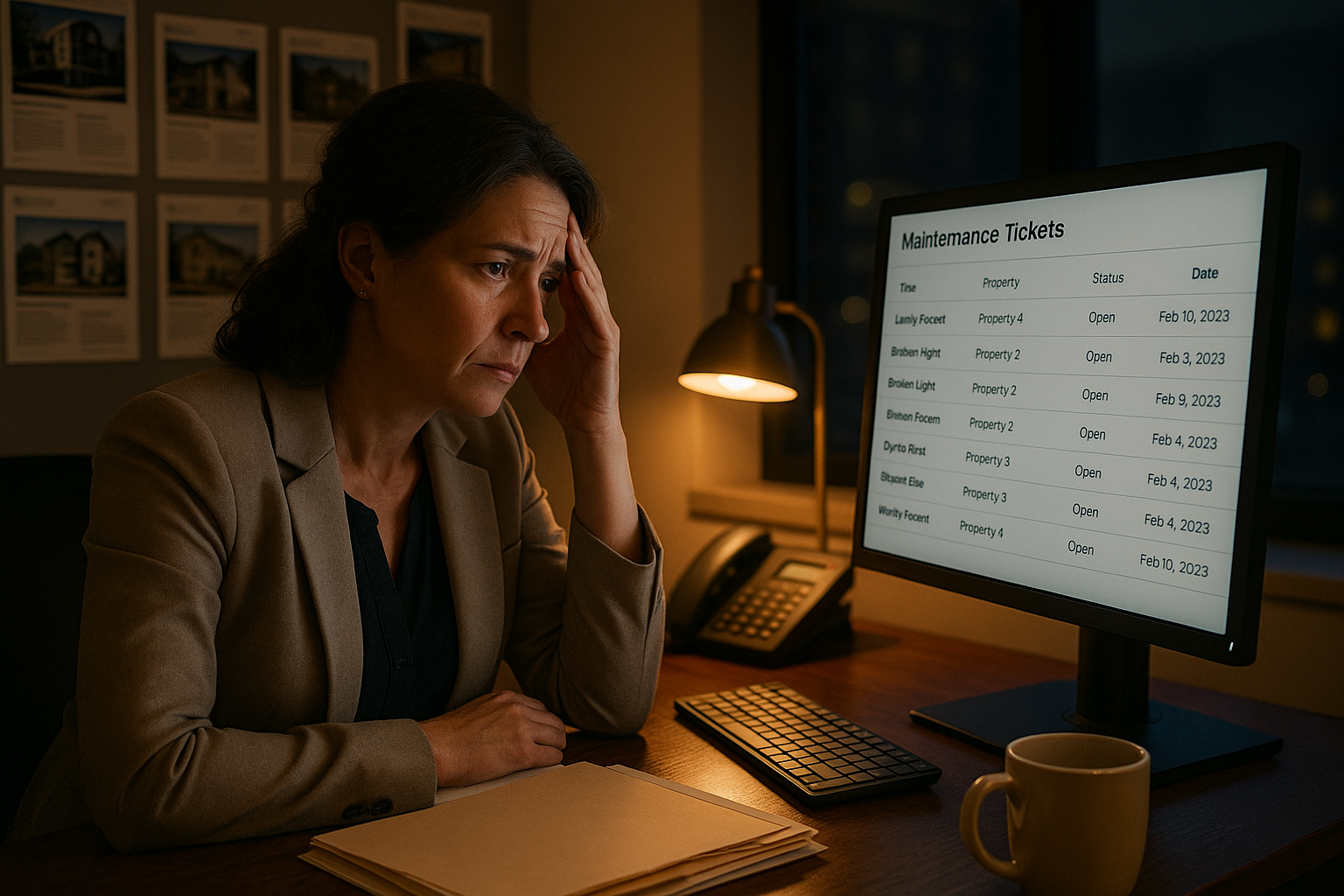
You have a voicemail timestamp: 9:32 PM Friday. But your maintenance ticketing system shows the first entry at 10:14 AM Saturday. That’s a 12-hour and 42-minute gap in your documented response protocol.
Your adjuster is now asking why there’s no record of after-hours escalation. Your tenant’s attorney is building a habitability claim around that same gap. And you’re realizing that a simple voicemail system just created a five-figure liability exposure.
Most Property Management Insurance Policies Require Documented Response Protocols
This isn’t about whether you’re responsive. It’s about whether you can prove it.
General liability and professional liability carriers for property management firms typically require documented procedures for emergency maintenance requests—especially those involving habitability: no heat, no water, gas leaks, lockouts in extreme weather, electrical failures, roof leaks.
The standard isn’t just “Did you respond?” It’s “Can you demonstrate a consistent, documented process for receiving, categorizing, and escalating emergency calls?”
A generic after-hours voicemail fails on three counts:
- No automatic escalation. The message sits until someone manually checks it. There’s no trigger, no alert, no workflow.
- No integration with your maintenance system. The voicemail lives in one place. Your ticketing system lives in another. The gap between them is where liability grows.
- No retrievable audit trail. You can prove when the voicemail was left. You can’t prove when it was received, reviewed, or escalated—or what criteria you used to categorize it.
The same problems exist with generic after-hours chatbots. They capture the message, but they don’t know your business. They can’t distinguish between a clogged drain and a sewer backup. They can’t trigger your on-call dispatch protocol. And they don’t integrate with your CRM or maintenance platform to create the documentation trail your insurance carrier expects.
The Real Cost: What a 36-Hour Documentation Gap Actually Means
Let’s walk through the scenario with real numbers.
Tenant calls Friday night, 9:30 PM. No heat. You don’t see the voicemail until Saturday morning. You dispatch maintenance by 10 AM. Pipe bursts at 6 AM Saturday. Water spreads for four hours before discovery.
Immediate costs: emergency plumbing repair, water extraction, drywall replacement, flooring in two units. Call it $18,000–$22,000.
Tenant displacement costs while repairs are completed: temporary housing, storage, per diem. Add $4,000–$6,000.
Now the tenant’s attorney files a habitability claim. They argue the 12-hour response gap violated the implied warranty of habitability. They’re seeking rent abatement, relocation costs, and damages. Settlement range: $8,000–$15,000.
Your insurance carrier covers most of it—but your deductible is $5,000, and your renewal premium jumps 18% because you now have a claim on record.
Total cost of that one missed Friday night escalation: $35,000–$48,000 when you account for the claim, the deductible, and the premium increase over 24 months.
And the root cause wasn’t that you didn’t care. It’s that your after-hours system didn’t create the documentation trail to prove you did.
What Property Managers Actually Need After Hours
The solution isn’t just answering the phone. It’s completing the workflow.
During business hours—Monday through Friday, 8:30 AM to 5:00 PM Pacific—Reliable Receptionist’s live receptionists handle tenant screening calls, owner inquiries, lease questions, and maintenance requests. Every call is logged into the Reliable Response CRM with full notes and next-step actions.
After hours, nights, and weekends, RR deploys a customized AI receptionist trained specifically on your property management business. This isn’t a generic chatbot that knows nothing about your portfolio. It’s integrated with your CRM and programmed with your emergency escalation protocols.
Here’s what that means in practice:
- Keyword recognition. The AI identifies emergency terms: “no heat,” “water leak,” “gas smell,” “lockout,” “no power,” “roof leak.” It categorizes the call as urgent and triggers your predefined workflow.
- Automatic dispatch. The system sends an SMS to your on-call maintenance tech with the tenant’s name, property address, unit number, and issue description. No manual handoff. No delay.
- CRM documentation. The entire interaction—call timestamp, issue description, escalation trigger, SMS sent, and tech acknowledgment—is logged in the Reliable Response CRM. You have a complete, retrievable audit trail from the moment the tenant called.
When your insurance adjuster asks what time you received notice and how you escalated it, you pull a CRM report that shows the exact sequence: call received 9:32 PM, categorized as emergency heating failure 9:33 PM, SMS dispatched to on-call tech 9:34 PM, tech acknowledged 9:41 PM.
That documentation doesn’t just protect you legally. It demonstrates to your owners, your tenants, and your insurance carrier that you operate with systems—not voicemail boxes.
Compliance Documentation Is Your Competitive Advantage
Property management is getting more regulated, not less. Habitability standards are tightening. Tenant protections are expanding. And insurance carriers are scrutinizing claims more closely.
The firms that grow in this environment are the ones that can demonstrate operational maturity: documented processes, consistent workflows, retrievable records.
Your after-hours call handling isn’t a minor operational detail. It’s a liability exposure, a compliance requirement, and a trust signal to owners.
Voicemail and generic chatbots can’t meet that standard. A customized AI integrated with your CRM can.
If you’re managing 50+ units and you’re still relying on voicemail after 5 PM, you’re one Friday night emergency away from a five-figure claim—and a documentation gap you can’t explain.
We’d be happy to show you how Reliable Receptionist handles after-hours escalation, CRM integration, and compliance documentation for property management firms. Book a 20-minute demo at reliablereceptionist.com and we’ll walk through your current process and show you exactly how the system works with your portfolio.
Ready to stop missing calls? Explore our live receptionist service, AI assistants, and Reliable Response — our free integrated CRM, or see our plans and pricing.