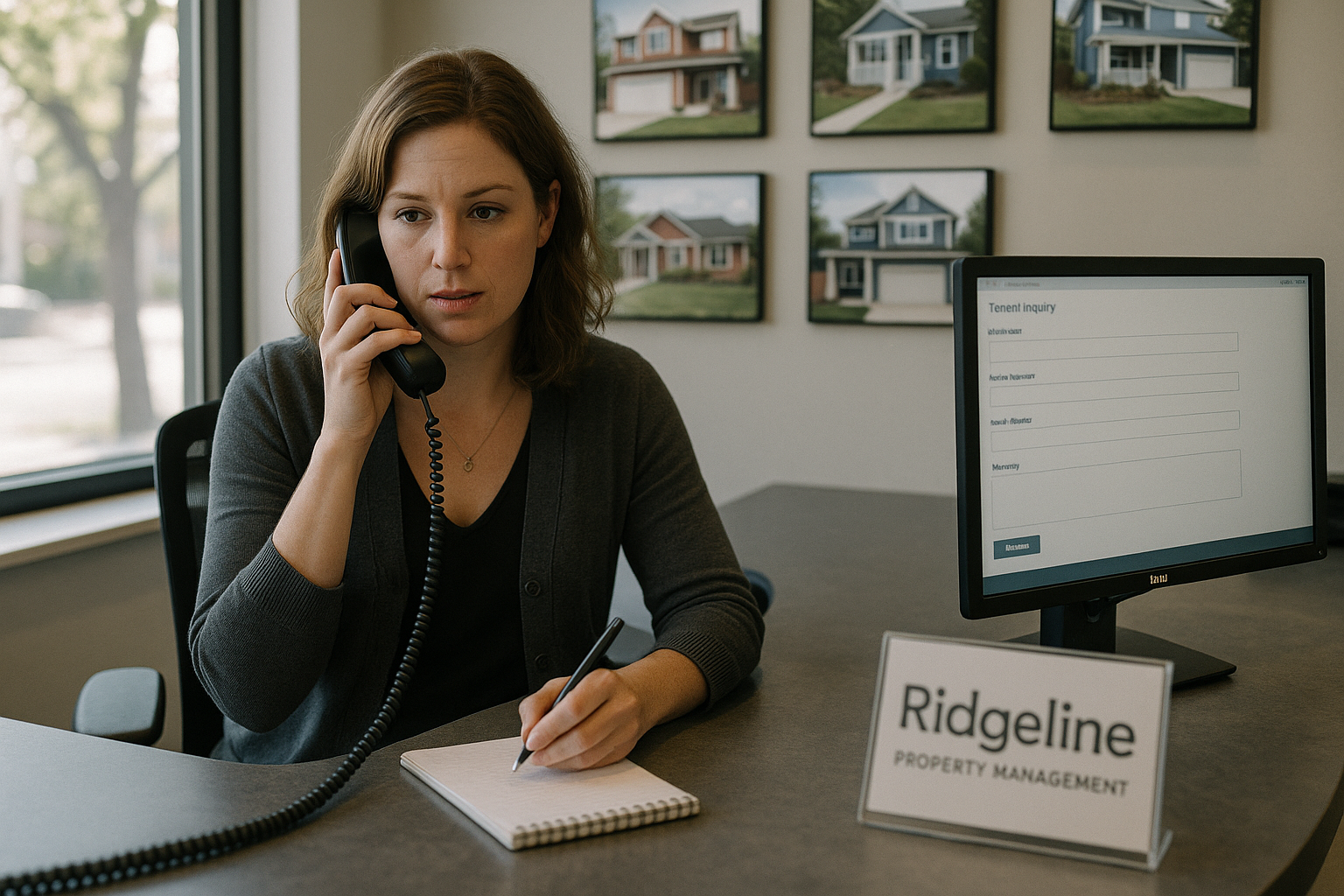

A full-time leasing coordinator costs between $62,000 and $74,000 annually when you account for salary, benefits, payroll taxes, training, and turnover — plus the hidden cost of missed tenant calls and lost lease renewals during vacations, sick days, and after-hours emergencies. A virtual receptionist service built for property management captures those calls for a fraction of the cost and eliminates the revenue gaps.
What Is the True All-In Cost of a Full-Time Leasing Coordinator?
Most property management companies budget for base salary when hiring a leasing coordinator — typically $38,000 to $46,000 for a full-time position handling tenant calls, maintenance requests, lease inquiries, and move-in coordination. But that number is only the starting point.
Add employer-paid payroll taxes at 7.65 percent, plus health insurance averaging $8,000 to $10,000 per year for single coverage. Include paid time off — 15 days of vacation plus 10 sick days and 8 holidays means you’re paying for 33 days when no one is at the desk. Factor in onboarding and training costs for the first 60 to 90 days, when productivity is low and mistakes are frequent. Then account for turnover, which in administrative roles averages 18 months. Recruiting, interviewing, background checks, and retraining cost another $6,000 to $8,000 per cycle.
The fully-loaded annual cost: $62,000 to $74,000. For a portfolio of 150 to 300 units, that’s a significant fixed expense — and it doesn’t solve the after-hours problem. Tenant emergencies don’t wait for business hours. Maintenance requests come in at 9 PM. Prospective renters call on weekends. If your leasing coordinator is off the clock, those calls go to voicemail or get routed to an on-call manager’s personal phone.
How Much Revenue Do You Lose When Calls Go Unanswered?
A missed lease inquiry isn’t just an inconvenience — it’s a quantifiable revenue event. The average rental unit in a competitive market receives 12 to 18 inbound inquiries per vacancy. If three of those calls go unanswered and the prospect moves on to the next property on their list, you’ve lost the opportunity to fill that unit. Every additional day a unit sits vacant costs you one day of rent. For a $1,800-per-month unit, that’s $60 per day.
Multiply that across turnover. If your portfolio has 20 percent annual turnover and you manage 200 units, that’s 40 vacancies per year. If each vacancy takes 5 days longer to fill because of missed or delayed call responses, you’ve lost $12,000 in rent annually — just from communication lag.
Maintenance requests follow the same pattern. A tenant calls about a leaking water heater at 7 PM. The call goes to voicemail. By the time someone returns the call the next morning, the leak has caused damage. Now you’re managing a repair escalation, a frustrated tenant, and potential liability. The cost of the delayed response far exceeds the cost of answering the call in real time.
What Happens When Your Leasing Coordinator Calls in Sick or Takes Vacation?
You have three options. Route calls to your office manager or another staff member, which pulls them away from their actual job. Let calls go to voicemail and deal with the backlog later. Or scramble to hire temporary coverage, which introduces someone unfamiliar with your properties, lease terms, and tenant history into the workflow.
None of these options maintain service quality. The temporary coverage doesn’t know which units are available, what your pet policy is, or how to handle an after-hours lockout. The office manager answering calls between property showings misses details and forgets to log the inquiry in your system. The voicemail backlog means prospects wait six hours for a callback — and by then they’ve already scheduled a showing somewhere else.
A virtual receptionist service eliminates this gap. Calls are answered live Monday through Friday during business hours by receptionists trained on your portfolio, lease terms, and maintenance protocols. After hours, a customized AI receptionist — not a generic bot — captures tenant and prospect information, schedules showings, routes emergency maintenance requests, and logs everything directly into your property management CRM. The service doesn’t take vacation days. It doesn’t call in sick. It doesn’t require health insurance or paid time off.
Why Do Generic Chatbots and Voicemail Fail Property Management Companies?
Some property management companies try to solve the after-hours problem with a generic AI chatbot or voicemail system. The chatbot can’t answer specific questions about available units, lease application requirements, or your pet deposit policy. It defaults to “leave a message and someone will call you back,” which is functionally identical to voicemail.
Prospective tenants don’t want to leave a message. They want to know if the two-bedroom unit is still available, whether you allow large dogs, and when they can schedule a showing. A generic bot can’t answer those questions because it doesn’t know your inventory, your policies, or your calendar.
A customized AI receptionist does. It’s trained on your specific properties, lease terms, application process, and maintenance workflow. It integrates with your property management software to check availability, schedule showings, and route emergency maintenance calls to the appropriate technician. It captures lead information — name, phone, email, preferred move-in date, unit type — and logs it directly into your CRM, triggering automated follow-up sequences so no inquiry falls through the cracks.
The difference isn’t AI versus human. The difference is a system that knows your business versus one that doesn’t.
How Does the Math Actually Work?
A full-time leasing coordinator costs $62,000 to $74,000 per year and works Monday through Friday, 9 AM to 5 PM. That leaves evenings, weekends, holidays, vacation days, and sick days uncovered — roughly 60 percent of the calendar.
A virtual receptionist service covers all inbound calls during business hours and deploys a trained AI receptionist after hours. The system integrates with your property management CRM, captures every lead, schedules showings, routes maintenance emergencies, and triggers follow-up workflows. You’re paying for a complete call-handling and lead-capture system, not just a person sitting at a desk.
Consider the revenue side. If improving call response prevents just two vacancies per year from extending by five days each, you’ve recovered $600 to $1,000 in lost rent per unit. If faster maintenance response prevents one escalated repair or one tenant move-out, you’ve saved $2,000 to $4,000. If better lead capture converts two additional lease applications annually, you’ve added $3,600 to $4,800 in first-month rent.
The ROI isn’t in comparing hourly rates. It’s in eliminating revenue leakage and service gaps that a fixed-schedule employee can’t solve.
What Should Property Management Companies Actually Optimize For?
The question isn’t whether you need someone to answer the phone. The question is whether you need that person on payroll, working fixed hours, with all the cost and coverage gaps that come with employment.
A leasing coordinator makes sense if you need someone physically on-site to conduct showings, process applications, coordinate move-ins, and manage day-to-day tenant interactions. But if the primary function is answering calls, capturing leads, scheduling showings, and routing maintenance requests, you’re paying $62,000 to $74,000 for work that a virtual receptionist system can handle more consistently and more completely.
You’re also paying for the gaps. The vacation days, sick days, training periods, and turnover cycles. The after-hours calls that go to voicemail. The maintenance emergencies that escalate because no one was available to route the call. The lease inquiries that never get returned because they came in on a Saturday.
A virtual receptionist service doesn’t eliminate the need for property management staff. It eliminates the need to staff a phone line 365 days a year with a full-time employee.
Reliable Receptionist combines live receptionists during business hours with a customized AI receptionist that knows your properties, integrates with your CRM, and handles after-hours calls the way your team would. Every call is answered. Every lead is captured. Every maintenance request is routed. Book a 20-minute demo at reliablereceptionist.com and see exactly how it works for your portfolio.
Frequently Asked Questions
What is the average salary for a full-time leasing coordinator in property management?
Base salary typically ranges from $38,000 to $46,000 annually, depending on portfolio size and market. However, the fully-loaded cost including benefits, payroll taxes, paid time off, training, and turnover expenses brings the total to $62,000 to $74,000 per year.
Can a virtual receptionist handle tenant maintenance emergencies after hours?
Yes, but only if the service uses a customized AI receptionist trained on your specific maintenance workflow — not a generic chatbot. Reliable Receptionist’s after-hours AI routes emergency calls to the appropriate technician, captures details, and logs the request in your property management CRM in real time.
How much revenue does a property management company lose from missed lease inquiry calls?
Every day a unit sits vacant costs one day of rent. If missed or delayed calls extend vacancy by just five days for two units annually, that’s $600 to $1,000 in lost rent per unit, or $1,200 to $2,000 total. Across a portfolio with regular turnover, the impact compounds quickly.
Do virtual receptionist services integrate with property management software?
The best ones do. Reliable Receptionist integrates with the Reliable Response CRM and major property management platforms, allowing real-time lead capture, showing scheduling, maintenance request routing, and automated follow-up workflows. Generic answering services typically don’t offer this level of integration.
What happens to call coverage when a leasing coordinator takes vacation or calls in sick?
Most property management companies either route calls to another staff member, let them go to voicemail, or hire temporary coverage. All three options degrade service quality and lead to missed inquiries, delayed responses, and lost leases. A virtual receptionist service provides continuous coverage without staffing gaps.
Is a virtual receptionist service only for after-hours calls?
No. Reliable Receptionist provides live receptionists Monday through Friday, 8:30 AM to 5:00 PM Pacific, plus a customized AI receptionist for after-hours and weekend calls. The service covers both business-hour and after-hours gaps, ensuring no call goes unanswered regardless of when it comes in.
Ready to stop missing calls? Explore our live receptionist service, AI assistants, and Reliable Response — our free integrated CRM, or see our plans and pricing.